Quiet Luxury Didn't Start in a Mood Board — It Started in Japan, Centuries Before Anyone Had a Pinterest
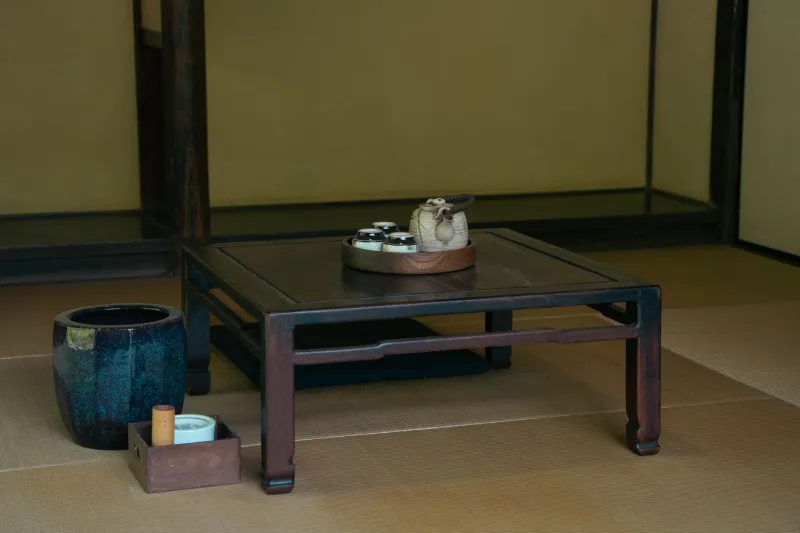
Somewhere between the third and fourth season of fashion media collectively discovering that "less is more," someone coined the phrase "quiet luxury" and the internet accepted it as new. Neutral tones. Impeccable construction. Nothing that screams, everything that whispers. The kind of dressing — and decorating, and living — that signals taste so refined it doesn't need to announce itself.
It's a genuinely appealing concept. It's also not new. It's not even Western. And the fact that it's being packaged and sold as a trend in 2023 and 2024 says something worth sitting with.
Japan Has Been Here. For Centuries.
Let's start with the vocabulary, because the vocabulary matters.
Ma (間) is a Japanese concept that translates, imprecisely, as negative space — the pause between notes, the empty room that makes the occupied one feel intentional, the silence that gives sound its meaning. It is foundational to Japanese architecture, garden design, music, and visual art. It is, in essence, the philosophical backbone of everything the "quiet luxury" aesthetic is trying to approximate.
Wabi-sabi is perhaps more familiar to Western audiences, though usually in a diluted form. It is the aesthetic philosophy that finds beauty in imperfection, impermanence, and incompleteness. The tea bowl with a crack. The moss on the stone. The faded textile that carries its age honestly. It is the opposite of the aspirational gloss that most luxury branding is built on — and yet it is its own deeply refined form of beauty.
Yohaku no bi (余白の美) translates to "the beauty of empty space" — a concept embedded in Japanese calligraphy, painting, and interior design that treats what is absent as equally meaningful to what is present. The negative space is not a lack. It is a choice.
These are not obscure academic concepts. They are living philosophies that have shaped Japanese material culture — clothing, architecture, ceramics, food presentation, garden design — for generations. And they are the intellectual and aesthetic ancestors of everything a Western mood board is currently calling "elevated minimalism."
How We Got Here: The Western Minimalism Pipeline
To be fair, the conversation about Japanese influence on Western design is not new either. The postwar period saw significant cross-pollination between Japanese aesthetics and modernist Western design. Architects like Tadao Ando influenced a generation of Western designers. The global success of designers like Issey Miyake, Rei Kawakubo, and Yohji Yamamoto in the 1980s brought a specifically Japanese approach to clothing — deconstructed, anti-body, radically restrained — into international fashion conversation.
But something interesting happens in the translation. The philosophy gets admired. The products get bought. The origin story gets quietly set aside.
KonMari — Marie Kondo's tidying method — is a recent and instructive example. When her book and Netflix show went viral in the West, it was often discussed as a lifestyle philosophy without much acknowledgment of its roots in Shinto principles around objects, space, and spiritual cleanliness. The method got extracted from its cultural context and repackaged as a productivity hack. The aesthetic remained. The meaning thinned.
The "quiet luxury" moment feels like a continuation of that pipeline. The look — linen, neutral palettes, natural materials, restraint — is being marketed as a new discovery when it is, at its core, a Western approximation of sensibilities Japan has been articulating for centuries.
Does It Matter If Gen Z Knows the Origin?
This is the genuinely interesting question. Because unlike previous generations of Western consumers, a meaningful segment of Gen Z does know. They've seen the TikToks about wabi-sabi. They've read the explainers about ma. They follow Japanese architects and ceramicists on Instagram. The cultural literacy is there, at least in pockets.
But does awareness change the consumption pattern? Or does it just add a layer of educated appreciation to the same extractive dynamic?
Here's where it gets complicated. Knowing that your beige linen trousers are spiritually adjacent to centuries of Japanese aesthetic philosophy does not, by itself, redirect any money or attention to Japanese designers, craftspeople, or cultural institutions. It doesn't necessarily mean you're buying from Japanese brands, learning the language, or engaging with the culture in any sustained way. It might just mean you use the word wabi-sabi correctly in a caption.
That said — and this is worth holding — awareness is not nothing. A generation that can name the source is a generation that can be held accountable for how they engage with it. The conversation about cultural credit in aesthetics is happening in ways it genuinely wasn't a decade ago. That's real, even if it's incomplete.
The Luxury of Knowing Where Something Comes From
There's an irony embedded in the quiet luxury trend that doesn't get discussed enough. The aesthetic valorizes restraint, authenticity, and things that carry genuine history. It positions itself against the hollow flashiness of logomania and fast fashion. It claims to care about craft, about integrity, about the real.
And yet the trend itself often ignores the most authentic version of what it's trying to be — which is Japanese. The most restrained, most historically grounded, most genuinely considered expression of these values exists in Japanese design tradition. To approximate it while not acknowledging it is, in a specific way, a failure of the aesthetic on its own terms.
If quiet luxury is really about authenticity, then authenticity includes knowing where the idea came from. It includes understanding that ma is not a mood — it's a philosophy with a lineage. It includes recognizing that the tea master Sen no Rikyū was articulating something about beauty and restraint in the 16th century that a Scandinavian interior design brand in 2024 is still trying to approximate.
The concept was never lost. It was just in a room the West wasn't looking at.
What This Means for How You Shop, Dress, and Decorate
None of this means you can't appreciate minimalism, or that neutral tones are culturally off-limits, or that every design choice needs a footnote. Culture moves. Aesthetics travel. That's not the problem.
The invitation is something simpler: know what you're drawing from. If the emptiness in your living room is something you find beautiful, sit with the question of why — and let that lead you somewhere. Maybe it leads you to a Japanese ceramicist whose work you now follow and buy. Maybe it leads you to read about ma in a way that actually changes how you think about space. Maybe it just means you stop calling it a trend.
Japan didn't invent restraint. But it named it, refined it, and built entire ways of living around it long before anyone put it on a mood board. That deserves more than a passing aesthetic nod.