😭 Doesn't Mean What You Think It Means — The Global Emoji Divide Gen Z Is Quietly Bridging
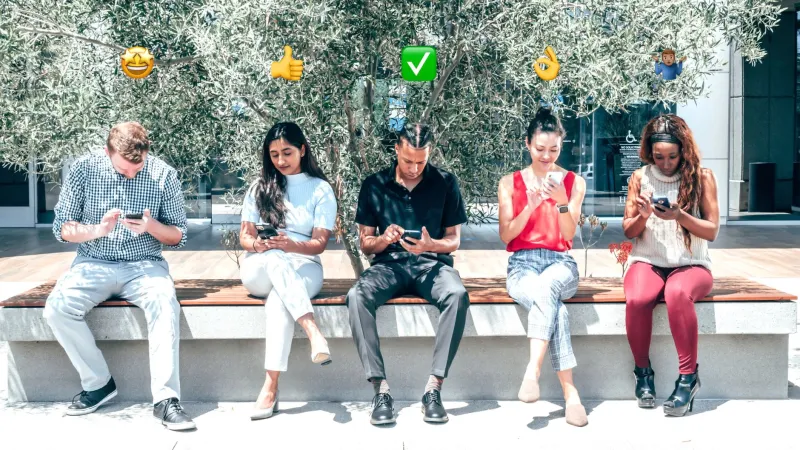
If you've ever typed 😂 into a group chat with anyone under 25 and felt the room go slightly cold, you already know something has shifted. That little yellow face — once the undisputed king of digital humor — has quietly been demoted. Not everywhere, and not all at once, but enough that paying attention to who is using what emoji reveals something genuinely fascinating about how culture travels through a phone screen.
This isn't just about one emoji getting canceled. It's about how billions of people across completely different cultural contexts are improvising a shared language in real time — and how Gen Z, more than any generation before it, is the one holding the translation guide.
The Crying-Laughing Problem Nobody Officially Announced
In the US, the shift away from 😂 has been widely documented in a sort of ironic, semi-joking way. Younger users started associating it with older millennials and corporate social media managers trying too hard. But the replacement wasn't uniform. Some Gen Z Americans landed on 💀 (as in, "I'm dead" from laughing). Others went full chaos with 🗿 or the increasingly unhinged "LMAOOO" with no emoji at all.
Meanwhile, in Japan, none of this drama was happening — because Japanese internet culture had already developed its own entirely separate visual vocabulary. Platforms like Twitter Japan and LINE are saturated with kaomoji, text-based emoticons like (´∀`)♪ or (╥﹏╥) that predate the smartphone era and still hold serious cultural weight. These aren't throwbacks; they're actively preferred by many Japanese users because they convey nuance that a standard emoji simply can't.
The face that "cries while laughing" in Japan often looks completely different from its Western counterpart, and more importantly, it means something slightly different — closer to overwhelmed delight than pure comedy.
Brazil Has Entered the Chat
Head to Brazilian Twitter (now X, but Brazilians still call it Twitter) and you'll encounter an entirely different ecosystem. The 🤣 emoji — the rolling-on-floor-laughing face — sees significantly higher usage in Brazil than almost anywhere else, but it's often deployed in ways that feel hyperbolic to American eyes. In Brazilian digital culture, humor tends to be louder and more physically expressive, and the emojis reflect that.
But what's really interesting is the rise of kkkkkk — a string of K's that functions as the Brazilian equivalent of "hahaha." It comes from the Portuguese word "cackle" (kakakaka), and it's so embedded in Brazilian internet culture that non-Portuguese speakers encountering it for the first time often think it's an error or a slur. It's neither. It's just a country doing laughter differently.
When Brazilian creators cross over to English-language TikTok, they bring the kkkkkk with them. And increasingly, American Gen Z commenters are adopting it without necessarily knowing where it came from — which is exactly how language has always spread.
What East Asian Digital Expression Gets Right
In South Korea, the dominant laughter expression online isn't an emoji at all — it's ㅋㅋㅋ (keukeukeu), the Korean equivalent, or ㅎㅎ for something softer and more polite. Korean internet culture also makes heavy use of specific emoticons that blend cuteness with irony in ways that Western emoji design hasn't quite cracked. The 🥹 emoji — the "holding back tears" face — became enormously popular in Korean and broader East Asian social media spaces before it really landed in the US, partly because it captures a specific emotional register (touched, overwhelmed, quietly moved) that Korean digital culture was already fluent in.
Chinese platforms like Weibo and WeChat have developed their own internal emoji ecosystems that rarely cross over to Western apps. The "dog head" emoji (🐶) on Chinese social media often signals self-deprecating humor or irony — something that would be completely opaque to an American user seeing it without context.
The Gen Z Translator Effect
Here's where it gets genuinely exciting: Gen Z, particularly in the US, is not confused by any of this. They're into it. The generation that grew up watching YouTube creators from every corner of the world, that learned cooking from Thai home cooks and fitness from Korean trainers, has developed a kind of cultural fluency that doesn't require a passport.
When a Gen Z American sees kkkkkk in the comments, they Google it. Or they ask. Or they just absorb it through repetition until it feels natural. This is how "no cap," a term rooted in Black American slang, ended up in the vocabulary of teenagers in the Philippines. It's how the Japanese wwww (derived from the word for "grass," kusa, which sounds like laughter) started appearing in English-language gaming communities.
The flow isn't one-directional either. American Gen Z exports its own digital expressions constantly — the skull emoji 💀 for extreme laughter is now used by young people across Latin America, Southeast Asia, and parts of Europe, often alongside their own regional equivalents.
What Gets Lost, and What Gets Found
Of course, translation is never perfect. The 😭 emoji — the one with tears streaming down a face — means something completely different depending on where you are. In the US, it's often used to express that something is so funny or so relatable it's emotionally overwhelming. In some East Asian contexts, it's used more literally for sadness or disappointment. This creates real miscommunication, especially in international comment sections where the same emoji appears in back-to-back comments with opposite intentions.
But maybe that's okay. Maybe the miscommunication is part of the process. Every generation that learned to communicate across cultural lines did it imperfectly at first — through borrowed slang, mispronounced words, and gestures that meant something slightly different than intended. The digital version of that is a skull emoji that one person reads as "I'm deceased from laughter" and another reads as "this is dark and ominous."
What Gen Z seems to understand intuitively is that context does a lot of the heavy lifting. The platform matters. The creator's background matters. The community around a post matters. And being willing to be slightly confused — to sit in the uncertainty of cross-cultural meaning — is actually a skill worth developing.
A Language Nobody Designed
There's no governing body for global emoji usage. No international committee decided that 💀 would become the new 😂 for American teenagers, or that kkk would travel from Brazil to global comment sections. It just happened, the way all living language happens — through use, repetition, adoption, and the human desire to connect.
What we're watching in real time is a generation building a genuinely new form of communication out of borrowed parts from everywhere. It's messy and imprecise and occasionally deeply confusing. It's also kind of remarkable.
The crying-laughing emoji didn't die. It just got context.