Ancient Cards, Modern Chaos: Why Gen Z Is Ditching the Couch for the Tarot Table
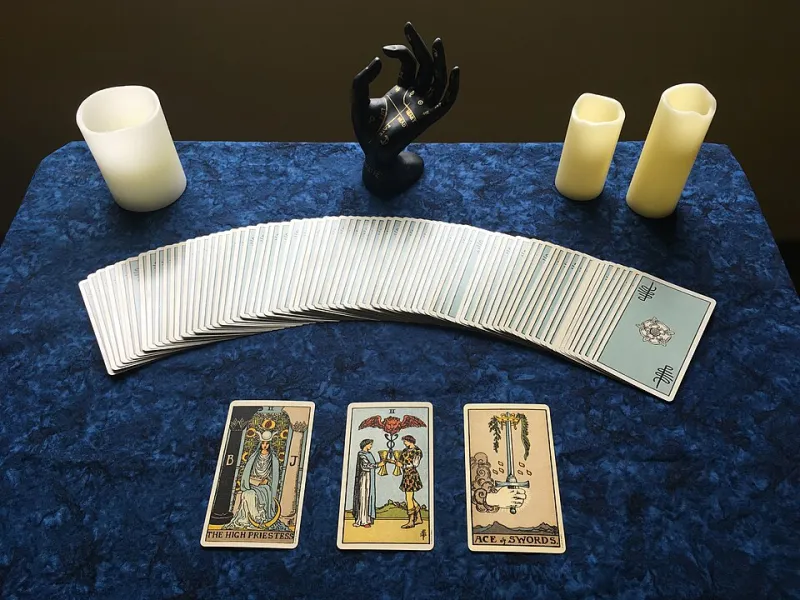
Photo: Nosferattus, CC0, via Wikimedia Commons
There's a particular kind of irony in the fact that the most therapy-literate generation in American history is quietly walking away from therapy. Gen Z practically invented the language — they can rattle off attachment styles at brunch, name their triggers before dessert, and identify a trauma response faster than most licensed counselors. And yet, somewhere between the $250 intake sessions and the six-month waitlists, a growing number of them started asking a different question: what if the answer isn't on that couch?
What's filling the gap isn't what most people expected. It's tarot decks spread across dorm room floors. It's Ifá readings booked through Instagram DMs. It's Peruvian mesa ceremonies streamed on YouTube at 2 a.m. It's a whole ecosystem of non-Western spiritual practices that Gen Z has quietly adopted — not as a trend, but as something that actually feels like it's working.
The Therapy Math Doesn't Add Up
Let's start with the obvious: mental healthcare in the United States is expensive, scarce, and wildly inconsistent. According to a 2023 report from the American Psychological Association, nearly 60% of adults who sought mental health treatment faced barriers — cost being the most common. For Gen Z, who are already navigating student debt, a brutal housing market, and the general psychological weight of existing in 2024, a $180-per-session therapist who's booked until March isn't a solution. It's a punchline.
Enter the tarot reader charging $40 on Venmo, available Thursday night, who somehow manages to say the exact thing you needed to hear.
"I'm not saying tarot replaced therapy for me," says Maya, a 24-year-old graphic designer in Chicago. "But when I couldn't get an appointment for three months and I was spiraling, I did a reading and it reframed my whole situation. It gave me a framework to think through what I was feeling. That has value."
The framing matters. Gen Z isn't necessarily abandoning psychology — they're supplementing it with something older, more accessible, and in many cases, more culturally resonant.
Not All Spiritual Systems Are Created Equal — And Gen Z Knows It
What makes this moment different from, say, the 1970s New Age boom is the specificity. Gen Z isn't just buying crystal sets from Urban Outfitters and calling it a spiritual practice (though some are, and that's a whole other conversation). A meaningful portion of them are actively seeking out traditional divination systems with deep cultural and historical roots — and learning about those roots in the process.
Ifá, the Yoruba divination system originating in West Africa, has seen a notable rise in interest among Black American Gen Z who are tracing their spiritual lineage back to practices that were deliberately suppressed during and after slavery. Practitioners like Iya Omitola, a babalawo-trained reader based in Atlanta, says her client base has shifted dramatically in the last three years.
"I used to see mostly older clients, people in their 40s and 50s reconnecting with something they felt was lost," she explains. "Now I have 22-year-olds booking consultations. They've done the research. They know the difference between Ifá and a generic tarot reading. That kind of intentionality is new."
Similarly, curanderismo — a healing tradition rooted in Indigenous and Spanish colonial Latin America — is experiencing a resurgence among Latinx Gen Z who feel disconnected from both Western medicine and the Catholicism their families practiced. Limpia ceremonies, which involve ritual cleansing using herbs, eggs, and prayer, are being discussed openly on TikTok and in community spaces in cities like Los Angeles, San Antonio, and Miami.
The Appropriation Question Nobody Wants to Ignore
Here's where it gets complicated — and Morhikaye isn't going to sidestep it.
The same openness that allows a Black Gen Z woman to reconnect with Yoruba spiritual practices also allows a white college student in Vermont to book an Ifá reading because it sounded interesting on a podcast. The same TikTok algorithm that amplifies Indigenous Andean healers also flattens their practices into aesthetic content for people who have no cultural connection to them whatsoever.
Cultural appropriation in spiritual spaces is a real and ongoing conversation, and practitioners are navigating it constantly.
"I don't turn people away based on background," says Daniela Reyes, a curandera based in East Los Angeles whose family has practiced for four generations. "But I do have conversations. I ask people why they're here. What they're looking for. Whether they understand where this comes from. The practice deserves that respect, and honestly, most people are willing to engage when you ask."
The line between appreciation and extraction isn't always clean, but Gen Z — for all its contradictions — tends to be more willing to sit with that discomfort than previous generations. Many practitioners describe their clients as genuinely curious about history and lineage, not just looking for a spiritual aesthetic.
What These Systems Offer That Western Psychology Doesn't
There's something structural happening here, beyond cost and access. Non-Western divination systems often operate from fundamentally different premises than Western clinical psychology — and those differences are exactly what draws some people in.
Western therapy, broadly speaking, is focused on the individual. It asks: what happened to you, how did it affect your internal world, and how can we fix it? That's not nothing. But many traditional spiritual systems situate the individual within a web of relationships — with ancestors, with community, with the natural world, with forces that extend beyond the self. For people who feel that Western individualism is itself part of what's making them sick, that reorientation is genuinely meaningful.
"When I do a reading, I'm not just talking about what's happening inside someone's head," says Yemi, an Ifá practitioner in Brooklyn. "I'm talking about their relationship to their lineage, to their community, to what they're supposed to be doing in this life. That's a different kind of conversation."
For a generation grappling with climate anxiety, systemic inequality, and the particular loneliness of digital life, being told that you are connected — to something older, larger, and more enduring than your immediate circumstances — hits differently than a cognitive behavioral framework.
The Question Worth Sitting With
None of this is to say that therapy is useless or that tarot cards are a substitute for real mental health care. The crisis in mental healthcare access is serious, and Gen Z deserves actual systemic solutions — not just more affordable alternatives.
But what this moment reveals is something important: a generation raised in the most psychologically self-aware era in American history is still hungry for something that mainstream Western culture hasn't been able to provide. Connection. Ritual. A sense that there are frameworks for understanding human experience that predate the DSM by several thousand years.
Ancient systems survived this long for a reason. Gen Z, characteristically, is just doing the research to find out why.