The $2 Kimbap That Embarrassed Every Overpriced Grocery Store in America
Let's set the scene. You're running late, hungry, and you duck into a 7-Eleven. Your options: a hot dog that's been rotating since the Obama administration, a sad triangle sandwich sealed in plastic wrap that tastes like regret, and a wall of chips. You grab the chips. You move on. You are not satisfied.
Now imagine a different version of that same scenario — except you're in Seoul, and you've just walked into a GS25. In the span of about forty-five seconds, you've spotted freshly made kimbap rolls, warm egg drop soup in a cup, tteokbokki in a microwaveable tray, a soft-boiled marinated egg for roughly seventy-five cents, and a yogurt drink that somehow tastes better than anything you've ever had at a sit-down brunch. You spend $4 total. You leave full and genuinely happy.
This is not a fantasy. This is Tuesday in Korea.
Convenience Stores as a Cultural Mirror
Here's the thing about Korean convenience stores — GS25, CU, 7-Eleven Korea (yes, a completely different beast from the American version), Emart24 — they didn't accidentally become food destinations. It was a deliberate, culturally-driven evolution rooted in how Korean society actually functions.
Korea is a fast-paced, densely urban country where people work long hours and eat on the move without wanting to sacrifice quality. The convenience store had to rise to meet that demand or get left behind. So it did. The result is an entire ecosystem of impulse food that's been engineered not just for speed, but for satisfaction — real, actual satisfaction, the kind where you don't feel vaguely hollow an hour later.
American convenience culture took a different road. It optimized for shelf life, caloric density, and brand recognition. We got Doritos and Slim Jims. They got onigiri and soft tofu soup. Both countries were solving for "quick food" — but they were solving for entirely different definitions of the word.
The Kimbap Situation
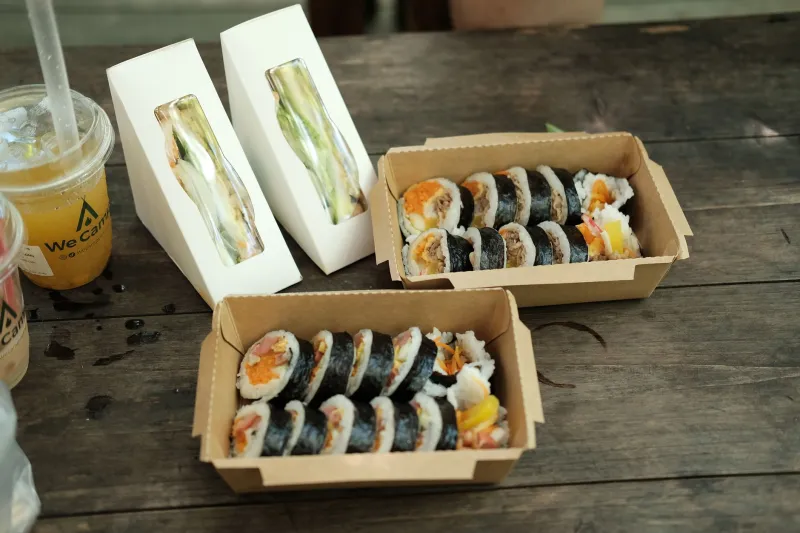
If you haven't had Korean convenience store kimbap, you need to understand what we're talking about. It's a seaweed-wrapped rice roll filled with vegetables, egg, and sometimes tuna or beef, sold for the equivalent of about $1.50 to $2.50. It's fresh. It's balanced. It has actual texture and flavor. You can eat it in three minutes standing up and feel like a person.
Now compare that to a $12 Whole Foods grain bowl that's been sitting under a heat lamp since 10 a.m., or a $9 "protein box" from Starbucks that's essentially a hard-boiled egg, some sad apple slices, and cheese cubes arranged with suspicious optimism.
The price gap is real. But the philosophy gap is even wider.
Korean convenience food operates on the assumption that the person buying it deserves a complete meal — something with carbs, protein, and vegetables that actually cohere as a dish. American grab-and-go food operates on the assumption that you're either in a hurry and will settle for anything, or you're health-conscious and will pay a premium to feel like you're making a good choice. There's very little middle ground where you get both quality and affordability without someone making it a whole thing.
Ingredient Transparency as a Default Setting
One of the less-discussed aspects of Korean convenience store culture is how normalized ingredient quality has become. Korean consumers are not passive about what goes into their food. There's a cultural literacy around ingredients — a baseline awareness of what's fresh, what's processed, and what's worth eating — that shapes what brands put on shelves.
This shows up in small but meaningful ways. Convenience store snacks in Korea regularly feature fermented ingredients, natural flavoring profiles, and lower sugar counts than their American equivalents. The popular banana milk? Real banana flavor, not artificial banana-adjacent syrup. The honey butter chips that broke the internet a few years back? Genuinely complex flavor engineering, not just salt-and-sweet dumped in a bag.
In America, ingredient transparency in convenience food is treated like a premium feature — something you pay extra for at a "better" store. In Korean convenience culture, it's closer to a baseline expectation. That's a massive difference in where the floor is set.
What 7-Eleven Korea Teaches Us About Ourselves
Here's a fun fact that tends to break American brains: 7-Eleven in Korea is legitimately good. Like, people go there on purpose, with intention, not just because it's the only option. The Korean franchise took the American brand and completely rebuilt its food identity from the inside out to match local standards.
That should tell us something. The problem was never the convenience store format. It was the cultural assumptions baked into what convenience stores are supposed to offer.
In the U.S., we've largely accepted that fast food is one thing and quality food is another, and the two don't really overlap unless someone's charging you $15 for a smoothie bowl and calling it "accessible wellness." Korea never made that split quite so absolute. Quick food and good food were allowed to be the same thing.
The American Snack Aisle Is Having an Identity Crisis
Walk down the snack aisle at a typical American grocery store and count how many products are competing on novelty versus how many are competing on genuine quality. You'll find Flamin' Hot versions of everything, a hundred varieties of the same four chip brands, and an entire section dedicated to things that are technically food but exist primarily to be photographed for TikTok.
None of this is entirely bad — novelty has its place, and honestly, Flamin' Hot Cheetos are a cultural artifact at this point. But the snack ecosystem as a whole is optimized for craving exploitation rather than actual nourishment. It's designed to make you want more, not to make you feel good.
Korean convenience snacks aren't immune to this either — the market there has its own wave of gimmick products and limited-edition flavors. But the foundation underneath is different. There's a deeper bench of genuinely satisfying, everyday food that doesn't require you to either lower your standards or empty your wallet.
What We Could Actually Learn From This
This isn't about shaming American food culture — it's about asking why the gap exists and what it reveals. The success of Korean convenience stores isn't a fluke. It's the product of a society that decided quick food and good food weren't mutually exclusive, and then built an industry around that belief.
For American consumers who've been burned by the overpriced-mediocre-salad industrial complex, Korean convenience culture offers a genuinely different vision of what eating on the go could look like. More and more Korean convenience store chains are eyeing the U.S. market — CU opened its first American location in Los Angeles, and the response was immediate and loud.
People were ready. They've always been ready. They just didn't know there was another option.
The $2 kimbap isn't just a snack. It's a quiet argument that you don't have to choose between fast and good — and that argument is landing.