When Ancient Mudras Meet the FYP: Bollywood Dance Just Rewired Gen Z's Brain
Your FYP Has Been Speaking Sanskrit This Whole Time
Scroll through TikTok on any given Tuesday and you'll probably catch at least three videos of someone doing that thing with their hands — fingers splayed, wrists rotating in those impossibly fluid figure-eights that look like they're casting a spell or summoning a deity. Comments flood in: "How is her wrist doing that??" "This is not human movement." "I've been trying to learn this for six months."
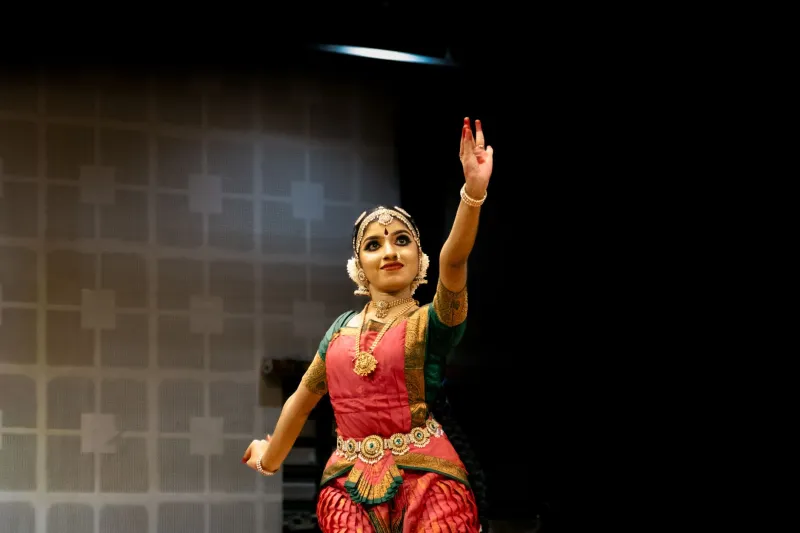
What those commenters are watching, whether they know it or not, is a living echo of mudras — sacred hand gestures that date back thousands of years in Indian classical dance traditions like Bharatanatyam, Kathak, and Odissi. These weren't invented for entertainment. They were devotional language. Each position of the fingers carried specific meaning: the Pataka mudra (flat hand, fingers together) could represent a flag, a cloud, or a forest depending on context. The Mayura mudra mimicked a peacock. The Tripataka was used to depict a flame or a crown.
Bollywood absorbed all of it — filtered it through film glamour, slapped a pop soundtrack on top, and sent it out into the world. And now, in 2024, a 19-year-old from suburban Atlanta is learning to nail the thumka (that signature hip drop) from a 45-second video and going viral for it. The pipeline from ancient temple ritual to viral trend has never been shorter.
Bollywood Was Always a Remix Culture
Here's something people outside India sometimes miss: Bollywood itself is already a hybrid. Indian film dance has always been a negotiation between classical forms and whatever was popular at the time — folk traditions, Western jazz, disco, hip-hop. The iconic moves you see in films starring Shah Rukh Khan or more recently Ranveer Singh aren't "pure" classical dance any more than jazz is pure African music. They're a gorgeous, chaotic conversation between traditions.
Choreographers like Farah Khan and Bosco-Caesar built careers translating that vocabulary into something cinematic and accessible. When Jai Ho or Dilbar hit global streaming platforms, Western audiences got their first real, sustained exposure to this movement style — not as "ethnic curiosity" but as full-on banger content.
The nagin dance (serpent moves, sinuous spine, slow weaving arms) became a meme long before TikTok existed. But TikTok gave it infrastructure. Suddenly there were tutorials, duets, and reaction videos. The algorithm, completely indifferent to cultural geography, just saw engagement — and pushed it everywhere.
The Moves That Broke Through First
Not every Bollywood move translated equally. A few specific gestures became the gateway drugs for Western creators:
The Eye-Hand Coordination Move — Following your own hand with exaggerated eye movement while the hand floats in front of your face. Rooted in classical training where the gaze (drishti) follows the hand's mudra. On TikTok, it reads as hypnotic, almost meditative. Creators started using it for transitions, for comedic timing, for sheer aesthetic flex.
The Thumka — That pelvic-hip-shoulder drop, usually punctuating a beat. It's everywhere in Bollywood item numbers and regional folk dance. American creators discovered it hits different when timed right, and started incorporating it into otherwise Western-style dance videos almost as punctuation.
The Neck Slide — Technically called Greeva Bheda in classical terminology, the ability to slide your neck sideways while keeping your shoulders still. This one broke TikTok. The comments on every tutorial are 80% people discovering their necks don't work like that and 20% people who apparently have hypermobile necks and didn't know it was special.
The Wrist Rotation Sequence — Those fluid, continuous wrist circles that layer into arm movements. Watching someone who's trained in it looks like their arms are made of water. Watching someone who just started learning looks like a robot having a beautiful crisis.
Respectful Appreciation vs. Blissful Ignorance — And the Space Between
Okay, let's be real about the complicated part. Not every Western creator doing Bollywood-inspired content knows what they're working with, and the discourse around that is... a lot.
Some creators go deep — they credit the choreographers, they learn the names of the forms, they collaborate with South Asian dance teachers and tag them properly. These videos are genuinely lovely. You'll find Indian-American creators in the comments saying things like "my grandmother would cry happy tears" and that feels like what cultural exchange is supposed to look like.
Other videos are more in the "I saw this in a movie and it looked fun" zone. The move is there, the context is gone, the original meaning has evaporated. Is that appropriation? Is it just how popular culture spreads? Honestly, the South Asian creator community itself is split on this. Some find it reductive. Others are genuinely thrilled that their cultural heritage is getting any traction at all in a media landscape that spent decades either ignoring or caricaturing South Asian identity.
What's clear is that the best of these cross-cultural moments happen when there's actual curiosity behind them — when the Western creator is genuinely trying to understand what they're doing, not just harvesting aesthetics.
What This Moment Actually Reveals
Here's the thing that gets lost in the appropriation debate: the fact that these moves are spreading at all says something genuinely interesting about where entertainment is going.
For decades, the global entertainment hierarchy was pretty simple. Hollywood exported. Everyone else imported. The idea that classical Indian movement vocabulary — something that was considered "too niche" or "too foreign" for Western mainstream consumption — could go viral organically, without a studio marketing push, through pure algorithmic word-of-mouth? That's new. That's actually kind of radical.
Streaming dismantled the gatekeepers. TikTok's algorithm doesn't care about national origin — it cares about watch time and shares. So when a Bollywood dance clip is genuinely compelling, it gets pushed. And it turns out a lot of this content is extremely compelling to audiences who never had access to it before.
South Asian creators who grew up feeling like their cultural references were invisible in American media are suddenly watching their nani's favorite dance style trend among people who've never seen a Bollywood film. That's disorienting and meaningful in equal measure.
The Next Chapter Is Already Being Written
What's coming next is even more interesting than what's already happened. A new generation of South Asian-American choreographers and creators is actively building content that doesn't ask permission — that blends Bharatanatyam footwork with hip-hop, that drops Kathak spins into K-pop covers, that creates something genuinely new from the collision.
Creators like Vidya Vox already showed this was possible in the music space. On the dance side, you're seeing similar fusion energy emerge from creators who are fluent in multiple movement languages simultaneously and refuse to keep them in separate boxes.
The ancient mudra and the trending audio are going to keep finding each other. The FYP doesn't care about cultural purity. But the creators who know the history, who can explain what the Tripataka hand position actually means while also making it look effortlessly cool in a 30-second video? Those are the ones building something that lasts beyond the trend cycle.
Your wrist probably still can't do that thing. But now at least you know what that thing is.